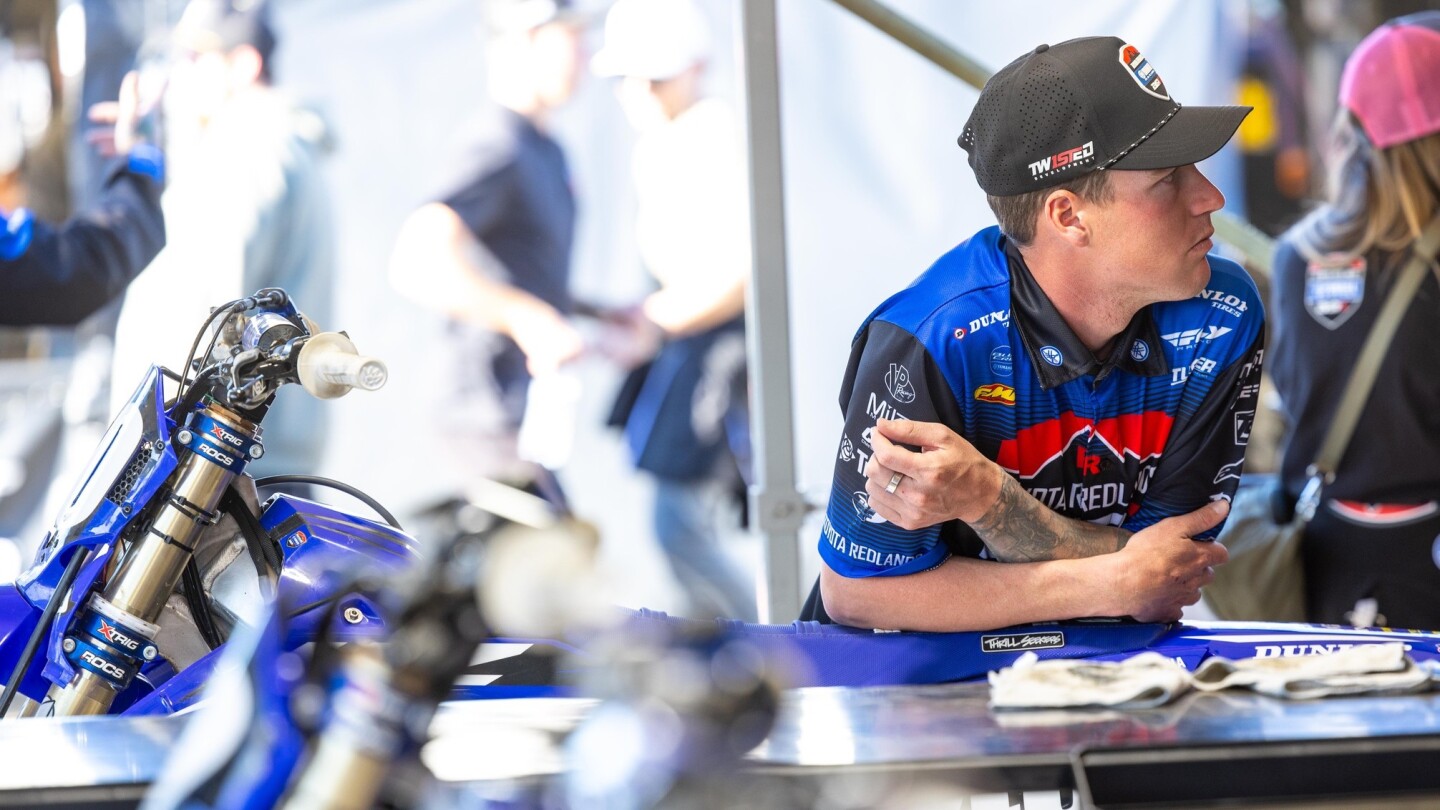
With age comes experience, but that is only part of the equation. In a sport where 30 was once considered old for riders and unheard of among team management, Bradley Taft will continue to defy those longstanding rules this week as the SuperMotocross World Championship returns to action at Protective Stadium in Birmingham, Alabama, for the first of three East / West Showdowns.
When the SuperMotocross field lines up this week, the 250 West divisional riders rejoin the traveling show, which means the three-rider Toyota Redlands BarX Yamaha team that Taft will be back in action for the first time since Round 6 in Seattle, Washington.
Younger than three of the top four challengers in the 450 points battle, Taft will turn 29 three days after the checkered flag waves over the Birmingham race, which will make him the youngest team manager in the paddock this week.
There is an adage that nothing can replace experience, and while that is true to an extent, it raises the question of what one means by experience. In a sport that is ever-changing, recency is equally important.
“I think [my age] helps with me being able to relate with the riders,” Taft told NBC Sports. “Obviously, some of the team managers are a lot older. And a lot of them have raced and done this themselves, but I feel like tracks have changed a little bit. Everything’s kind of changed a little bit. So, although they still have a ton of knowledge, I just think it’s a little bit different from my side.”
Taft was working his way through the SuperMotocross ranks as a racer much more recently than his managerial rivals. He raced in the Monster Energy Supercross and Pro Motocross series from 2016 through 2019, scoring three top-10s in the 250 SX West division and one top-10 in the 450 class. He finished 10th in the 2018 Australian Supercross championship.
“I think the riders see it a little bit different when I’m like, ‘Hey, you need to go hit that triple, triple out there or whatever,’ ” Taft continued. “They’re like, ‘Okay, this guy has seen it recently.’ I kind of know what they’re seeing. That helps a little bit with relating to the riders. That’s been the biggest advantage that I’ve had as far as being closer in age with them and having raced recently.”
Taft doesn’t have to dig too deeply in his brain for sensory memories of how the bike should feel. In addition to recalling his racing experience from six or seven seasons ago, he rides regularly with his current brigade.
“Working with Bradley Taft is, I feel like it’s honestly going to help me a lot this year, with the way he uses his words, and also he raced not long ago,” Lux Turner, 20, told NBC Sports earlier this season as he lined up to practice for the San Diego Supercross. “He literally got on my bike and did the photo shoot for me, and was ripping, hitting the whoops. The dude knows how to ride, and he still knows how to ride. So it’s pretty impressive, and I think that helps him a lot with the way he talks to us, training-wise. I think it’s amazing.”
Speaking the Same Language
An added benefit of Taft’s close age to his riders is that they speak the same language.
“I’m able to understand certain stuff they’re saying about the bike,” Taft said. “Some of the riders, with the kind of feedback they give, you kind of have to decipher it. They’re not the best with giving feedback or what they’re feeling on the bike, so you kind of have to pull it out of them. And I think that’s been an advantage for me. It’s like I’m able to converse and say, ‘Okay, what are you feeling here? What are you feeling there?’ ”
That correlates even when the rider and team manager are not comfortable with the same setup.
Dylan Schwartz knows that Taft does not typically like the setups he uses; they are not ones Taft would implement if he were riding the Yamaha in competition, and yet Taft will still climb on Schwartz’s bike to get a feel for what the racer is experiencing.
At 23, Schwartz has a few more years on the bike than his teammates Turner or Parker Ross, both 20, but communication is equally important to him.
“I feel like a bigger help having him as the manager just to help us, being younger riders, to get through it,” Schwartz said. “It definitely helps when he gets on the bike and tries our setups, and he still goes really fast.”
And as for the other element of experience, the one that comes with a few more decades under one’s belt, Taft accounts for that also.
Bradley Taft bring experience and youth to the Barx Yamaha SMX team